Synthetic Monitoring vs Real User Monitoring: The Complete Comparison
Two Lenses on the Same Question
Every team running a website or application eventually asks the same deceptively simple question: is it working, and is it fast enough? Answering it well turns out to require two fundamentally different approaches, and confusing them is one of the most common mistakes in reliability engineering. Those two approaches are synthetic monitoring and real user monitoring, usually shortened to RUM.
Synthetic monitoring is proactive. It runs scripted checks against your service on a fixed schedule from controlled locations, whether anyone is using the site or not. Real user monitoring is reactive in the best sense: it collects performance data from the actual browsers and devices of the people using your service, capturing exactly what they experience. One is a controlled laboratory experiment; the other is a field study of the real world.
Neither is "better." They answer different questions, they have different blind spots, and a mature monitoring strategy uses both. This guide explains precisely how each works, what it measures, where it excels, and where it fails, so you can decide what your stack actually needs. If you are just getting started, the foundation is reliable website monitoring that tells you the instant something breaks; everything else builds on that.
What Is Synthetic Monitoring?
Synthetic monitoring, sometimes called active or proactive monitoring, works by generating artificial traffic against your service on a schedule. A monitoring system runs predefined checks: request this URL, run this login flow, call this API endpoint, and records whether the check succeeded and how long it took. Because the traffic is scripted and repeatable, every result is directly comparable to the one before it.
The checks range from simple to sophisticated:
Uptime and availability checks: does the URL return a healthy status code? This is the bedrock of uptime monitoring.
Response time checks: how long does the server take to respond, measured consistently from the same probes?
Transaction checks: scripted multi-step journeys such as log in, search, add to basket, check out, run end to end to confirm a critical path still works.
API checks: validating that an endpoint returns the right status, the right payload, and within an acceptable time, covered in depth in our API monitoring guide.
Certificate and protocol checks: confirming SSL certificates are valid and not about to expire.
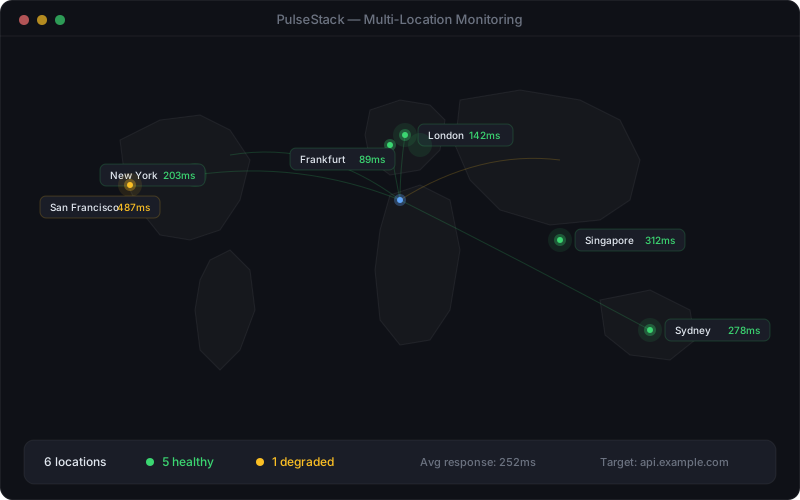
Synthetic checks run from fixed probe locations around the world, giving consistent, comparable measurements of availability and performance from each region
The defining characteristic of synthetic monitoring is control. You decide what is tested, how often, and from where. A check running every 30 seconds from probes in London, New York and Sydney produces a clean, continuous baseline that is unaffected by how many real users happen to be online. That control is exactly what makes synthetic monitoring the right tool for catching outages the moment they begin, long before a customer would have noticed.
What Is Real User Monitoring?
Real user monitoring takes the opposite approach. Instead of generating traffic, it observes the traffic you already have. A small piece of instrumentation, typically a JavaScript snippet in the browser or an SDK in a mobile app, measures the actual experience of every real session and reports it back: how long the page took to load, how quickly it became interactive, whether an error was thrown, and on what device, browser, network, and location.
Because RUM samples reality rather than simulating it, it captures things synthetic checks structurally cannot:
The true diversity of your users: every browser version, screen size, operating system, and network condition your audience actually uses, not the handful you thought to script.
Core Web Vitals in the wild: metrics such as Largest Contentful Paint, Interaction to Next Paint, and Cumulative Layout Shift, measured on real hardware under real network conditions rather than in a pristine lab.
Geographic and network reality: how the site performs for a user on a congested mobile connection in a rural area, not just from a well-provisioned data centre.
Real error rates: the JavaScript exceptions and failed requests that only surface with a particular combination of browser, extension, and user behaviour.
The strength of RUM is authenticity. It measures what people genuinely experience, which is ultimately the only thing that matters. Its weakness is the mirror image of that strength: it can only measure experiences that actually happen. If nobody visits a page, RUM tells you nothing about it, and it can never warn you about a problem before a real user has already suffered it.
Synthetic vs RUM: The Head-to-Head Comparison
The clearest way to understand the two approaches is to line them up against the dimensions that matter operationally. They are not competitors so much as complements, each strong exactly where the other is weak.
Coverage vs Reality
Synthetic monitoring covers what you tell it to, continuously and predictably, including paths that get little traffic but are business-critical (a checkout flow at 3am, a rarely-used but high-value admin function). RUM covers only what real users touch, but it covers all of it, across every device and condition you would never think to script. Synthetic gives you deterministic coverage of chosen paths; RUM gives you probabilistic coverage of everything real.
Detection Speed
This is where synthetic monitoring wins decisively. Because it runs on a schedule regardless of traffic, it detects an outage within seconds of it starting, even at 4am when no customers are online. RUM cannot detect a problem until a real user hits it, which for low-traffic pages or off-peak hours can mean a long, silent gap. If fast detection is your priority, and for shortening mean time to recovery it should be, synthetic monitoring is non-negotiable.
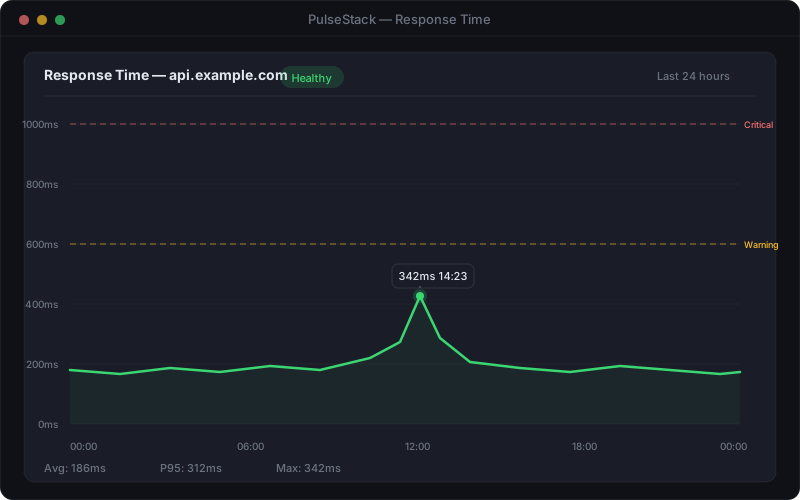
Synthetic checks produce a clean, comparable performance baseline; real user data reveals the full distribution of experiences that a single scripted probe can never capture
Consistency vs Variability
Synthetic measurements are repeatable. Run the same check from the same probe and variations reflect genuine changes in your service, which makes synthetic data ideal for spotting regressions and comparing performance before and after a deploy. RUM data is inherently noisy because the real world is noisy: a slow reading might mean your site degraded, or it might mean a user was on hotel wifi. RUM tells you the truth but requires statistical thinking to interpret.
Pre-Production vs Production
Synthetic monitoring can run against staging and pre-production environments before you ship, catching problems before any user is exposed. RUM by definition only works once real users are present, so it is purely a production tool. If you want to validate a release before it reaches customers, only synthetic can do it.
Cost and Complexity
Synthetic monitoring is simple to stand up: point a check at a URL and you have data in seconds. RUM requires instrumenting your application, handling the privacy implications of collecting user data, and processing a high volume of events. Synthetic is the faster path to immediate value; RUM is a larger investment that pays off in depth of insight.
The Blind Spots Each One Has
Understanding where each approach fails is more useful than understanding where it succeeds, because the gaps are exactly where incidents hide.
What Synthetic Monitoring Misses
Synthetic checks only see what they are scripted to see. A monitor watching your homepage and checkout will happily report all green while a third feature that no check covers is completely broken. Synthetic traffic also comes from data centres on fast, stable connections, so it systematically understates the pain of a real user on a slow mobile network. And because the requests are artificial, synthetic monitoring cannot reveal how the genuine mix of browsers, devices, and user behaviours in your actual audience performs. It answers "does the path I chose work?" but never "how does my real audience actually experience the product?"
What Real User Monitoring Misses
RUM's blind spots are the direct consequence of its dependence on real traffic. It cannot detect an outage before a user hits it, which makes it useless as an early warning system. Low-traffic pages generate too little data to draw conclusions from. It cannot test anything in pre-production. And critically, if an outage is total, that is, the page fails to load at all, the RUM script may never even execute, so a complete failure can produce a suspicious silence in your RUM data rather than a clear alarm. Relying on RUM alone means you learn about your worst outages last.
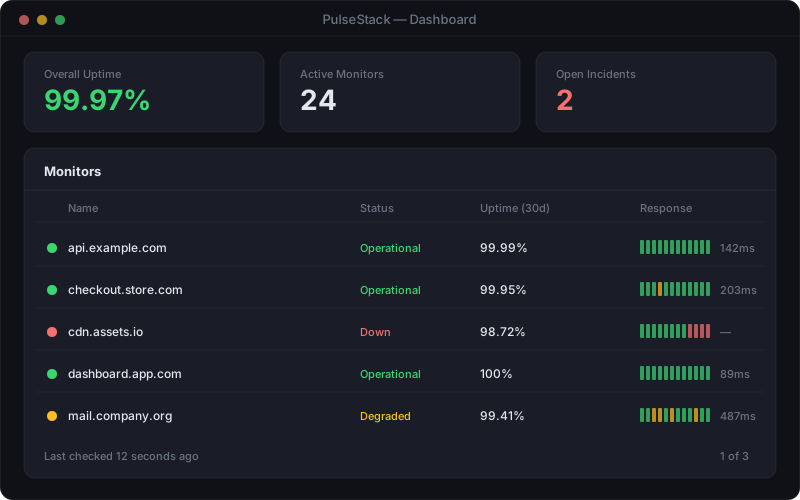
A complete monitoring picture layers synthetic availability checks with real user experience data, so nothing falls into either tool's blind spot
Lay the two lists side by side and the conclusion is obvious: the blind spots of one are the strengths of the other. This is not a coincidence. It is the entire reason mature teams run both.
When to Use Each (and When to Use Both)
The right choice depends on what you are trying to protect and how far along your monitoring maturity is. Here is a practical way to reason about it.
Start With Synthetic
If you have nothing today, start with synthetic monitoring. It delivers the highest-value capability first: fast, reliable detection of outages and performance regressions on the paths that matter most. It is quick to configure, it works in pre-production, and it protects revenue-critical journeys around the clock regardless of traffic. For most businesses, comprehensive synthetic website monitoring covering uptime, response time, transactions, HTTP status, and certificates is 80% of the value for 20% of the effort. Add multi-location checks so a regional outage is never invisible.
Add RUM as You Scale
Once synthetic monitoring is catching your outages, real user monitoring becomes the natural next investment, especially if performance is a competitive differentiator or your audience spans a wide range of devices and networks. RUM tells you which real segments are suffering, validates that your synthetic baselines reflect reality, and surfaces the long tail of browser-specific and network-specific problems that scripted checks will never find. It turns "the site is up" into "the site is genuinely fast for the people who use it."
Use Both for a Complete Picture
The strongest strategy layers them deliberately. Synthetic monitoring is your alarm system and your regression detector: it tells you the instant something breaks and feeds clean data into your incident management workflow and your SLOs. RUM is your ground truth: it confirms whether the experience your users actually receive matches the promise your synthetic numbers imply. When a synthetic check goes green but RUM shows users still struggling, you have learned something no single tool could have told you. Together they cover the full spectrum from "is it up?" to "is it genuinely good?"
Choosing the Right Foundation
Synthetic monitoring and real user monitoring are not rivals to be chosen between; they are two halves of a complete view. Synthetic gives you control, speed, and predictability: the ability to catch failures before customers do and to test the paths that matter on your terms. RUM gives you authenticity: the unfiltered truth of what real people experience on real devices. The blind spots of each are precisely the strengths of the other, which is why the answer to "synthetic or RUM?" is, for any serious operation, "both, in that order."
For nearly every team, the correct first move is unambiguous. Fast, reliable detection is the foundation everything else depends on, and that is exactly what synthetic monitoring delivers. You cannot recover from an outage you have not noticed, you cannot measure an SLO without a clean signal, and you cannot protect revenue on a checkout flow that only gets exercised at 3am unless something is actively testing it. Real user monitoring then layers depth and realism on top of that solid base.
PulseStack starts you with the layer that matters most: continuous, multi-location synthetic monitoring that catches problems within seconds and keeps watch whether or not anyone is online. Explore the full feature set to see how uptime, response time and certificate checks fit together, and review the plans to find the right fit for your stack. The best monitoring strategy is the one that never lets a failure reach a customer unseen.
Share this page
Start monitoring your infrastructure today
5 free monitors, no credit card needed. Set up in under 30 seconds.